Your brain has been louder than it needs to be
Qufit works by giving your body the Qufit Signal — a thin sensory signal on your skin, primarily on the belly, that becomes an anchor for your own intention when food impulses arise.*
Food noise is real.
And it’s running constantly.
The modern world is engineered to make you eat. Ultra-processed packaging, algorithmically targeted food ads, endless delivery apps, supermarket layouts designed to trigger impulse buys — your environment is working against you.
Research shows the average person makes over 200 food-related decisions daily, most of them below conscious awareness.
We all know what’s good for us. But knowing and doing are different things — we react before we’ve even asked: do I actually need this right now?
Fig. 1 — Neural activity: scattered food impulses vs. sensory-anchored awareness
From wax to signal to intention
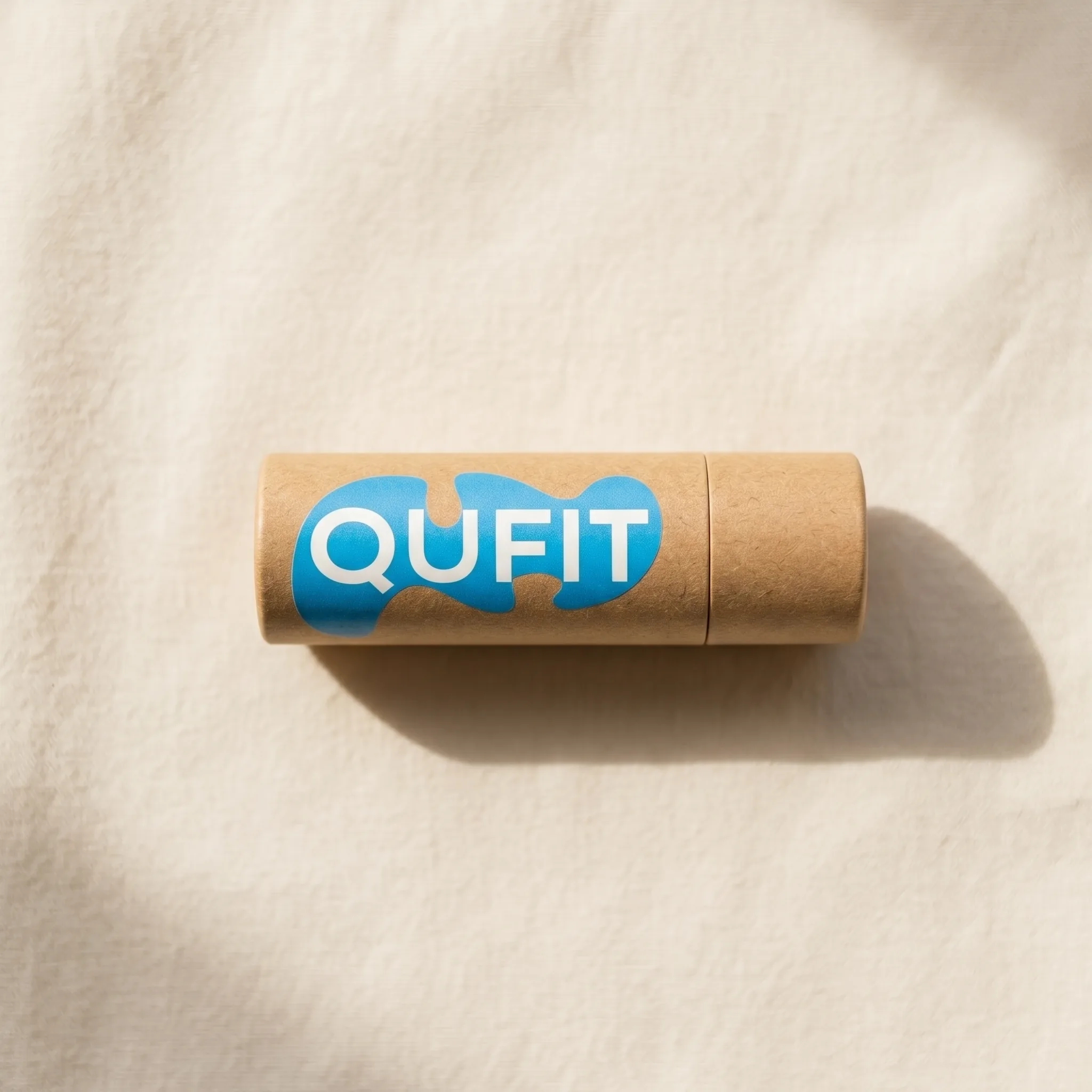
Qufit Stick is a correlation-engineered wax that creates the Qufit Signal on your skin — a gentle, stable tactile pattern that anchors your eating intention through touch.
We program the wax
A cosmetic wax base is physically conditioned to reproduce the dynamic behavior of a reference material.
It creates a signal on your skin
The material's surface micro-dynamics create a gentle, stable tactile signal detectable by the skin.
It anchors your eating intention
Applied to the skin, it acts as a physical anchor — a subtle, continuous reminder of your eating intention throughout the day.
We program the wax
A cosmetic wax base is physically conditioned to reproduce the reference material's behavior — no chemical additives.
No chemical additivesIt creates a signal on your skin
The material's surface micro-dynamics create a gentle, stable tactile signal — no electronics, no active substances.
No electronics · No active substancesIt anchors your eating intention
Applied to the skin, it acts as a physical anchor — a subtle, continuous reminder of your eating intention all day.
One swipe · All day · InvisibleFig. 5 — From physics to product. The CCIM-DP platform applied to a cosmetic wax stick creates a passive sensory interface that supports mindful eating throughout the day.
From your skin to your choices
What happens after you apply — in three quiet steps.
Apply
One gentle swipe on clean skin. The material creates a micro-tactile pattern — a subtle, continuous signal your nervous system starts processing immediately.
Mechanoreceptors: Meissner, Pacinian, Merkel, RuffiniSignal
That signal reaches your brain within milliseconds — using the fastest sensory pathway in your body, into the areas that connect physical feelings with everyday decisions.
A‑beta fibres → Dorsal columns → VPL thalamus → S1/S2 cortexAnchor
Your brain links what you feel on your skin with your eating intention — one connected state. When a craving hits, the signal is still there, quietly re‑activating the decision you already made.*
Insula + PPC + Prefrontal Network → Intention contextFig. 2 — Somatosensory pathway: skin to prefrontal cortex
Grounded in behavioural science
Qufit’s mechanism draws on three well-established principles of human behaviour and neuroscience. Each has decades of peer-reviewed research behind it.
Ritual psychology
Physical rituals create mindful involvement, enhancing engagement with the present moment and personal intention. The act of applying — pressing, swiping, pausing — is itself part of the mechanism, not just a delivery method.
Vohs, Wang, Gino & Norton (2013) — Psychological ScienceView the research
Method: Four experiments with over 200 participants tested whether rituals (systematic, repeated gestures) prior to consumption enhanced the experience.
Key finding: Ritualistic behaviour significantly increased enjoyment, perceived flavour intensity, and willingness to pay — even when the ritual had no functional relationship to the food.
Vohs, K. D., Wang, Y., Gino, F., & Norton, M. I. (2013). Rituals enhance consumption. Psychological Science, 24(9), 1714–1721.
Implementation intentions
“If-then” plans anchored to physical cues reliably improve follow-through on behavioural goals — even under stress and cognitive load when willpower is depleted. Qufit provides the physical cue; you provide the intention.
Gollwitzer (1999) — American PsychologistView the research
Method: Meta-analysis of 94 independent studies examining the effect of forming specific "if X happens, then I will do Y" plans on goal attainment.
Key finding: Implementation intentions had a medium-to-large effect size (d = 0.65) on goal achievement, outperforming motivation and willpower alone across health, academic, and interpersonal domains.
Gollwitzer, P. M. (1999). Implementation intentions: Strong effects of simple plans. American Psychologist, 54(7), 493–503.
Habit formation via cues
Consistent sensory cues paired with intention create stable automatic associations. Median automaticity is reached at 66 days — and missing one day doesn’t reset progress. The cue-routine-reward loop is the foundation of lasting change.
Lally, van Jaarsveld et al. (2010) — EJSPView the research
Method: 96 participants chose an eating, drinking, or exercise behaviour to carry out daily for 12 weeks. Automaticity was measured using the Self-Report Habit Index.
Key finding: Median time to reach automaticity plateau was 66 days (range: 18–254 days). Missing a single day did not materially affect habit formation — consistency, not perfection, drives the process.
Lally, P., van Jaarsveld, C. H. M., Potts, H. W. W., & Wardle, J. (2010). How are habits formed. European Journal of Social Psychology, 40(6), 998–1009.
“By day 3, I noticed I was pausing before opening the fridge.”
Your daily ritual starts with one moment.
One mindful application. A physical anchor for your eating intention. All day long.
Begin Your Journey 30-day guarantee
 Free shipping
 Cancel anytime